
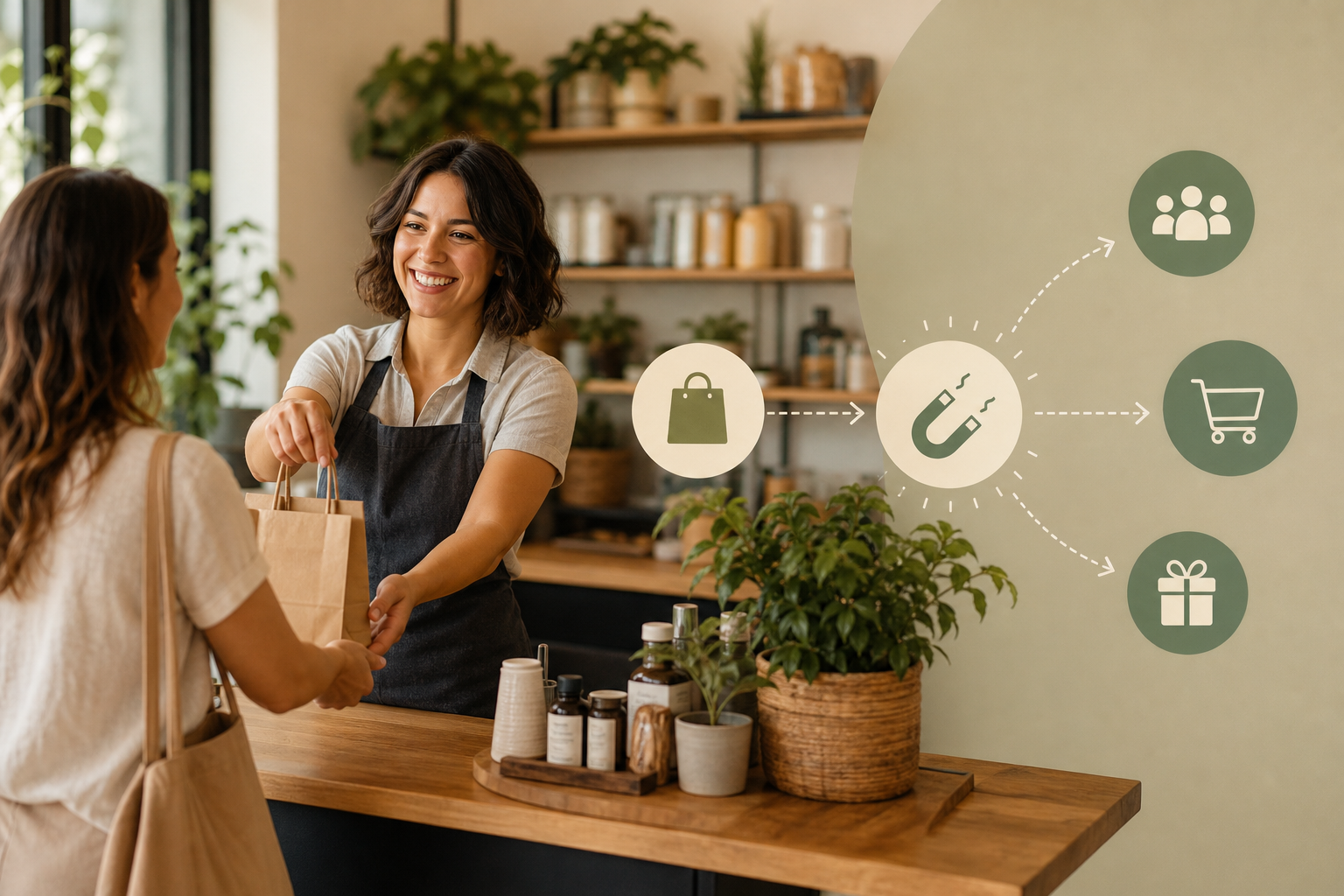
A discounted offer can fill your shop with first-time buyers. The hard part is making sure they come back. A loss leader strategy for small business only works when you treat the promotional item as a controlled acquisition cost and pair it with a plan to convert that expensive first visit into profitable repeat business.
Most shops stop at the discount. They mark down a popular item, hope the margin on everything else in the basket covers the loss, and assume customers will return because the experience was good. Some will. Many won't. Without a structured follow-up, you are subsidizing one-time transactions and calling it marketing.
This guide walks through an eight-step framework that caps your subsidy, increases basket value, captures customer contact, and uses timed rewards to earn the second visit instead of waiting for it.
What a loss leader strategy actually does
A loss leader is a product sold below cost to attract customers into the store or onto the site. The shop accepts a small, planned loss on that item in exchange for the chance to sell full-price products in the same transaction and to convert the shopper into a returning customer.
The strategy fails when too many people buy only the discounted item, when the rest of the basket does not generate enough margin to offset the subsidy, or when the customer never comes back. It succeeds when the shop controls all three variables: the size of the loss, the value of the basket, and the likelihood of a repeat visit.
You are not hoping to break even on the leader itself. You are buying a customer at a known price, then working to make that customer worth more than the acquisition cost over time.
Step 1: Choose a genuinely attractive leader
Discount something customers already want and buy regularly, not a slow-moving product you are trying to clear. A recognizable item with frequent purchase intent brings people through the door. An obscure markdown does not.
Pair the leader with complementary products that carry healthy margins. A discounted candle next to full-price accessories. A low-priced drink with a pastry. The leader creates the visit; the add-ons create the profit.
Step 2: Set a hard limit on the subsidy
Calculate the per-unit loss: item cost minus promotional price. If an item costs you twelve dollars and you sell it for ten, you lose two dollars per unit. Multiply that by the maximum number of units you will sell during the promotion, and you have your total exposure.
Limit the promotion by quantity per customer, total duration, or eligibility rules. Quantity caps also discourage cherry-pickers who buy only the deal and leave. Know the worst-case cost before you launch.
Step 3: Check the basket math before launching
Estimate the gross profit from add-ons and compare it with the total subsidy. One grocery example in the research showed milk sold for one dollar ninety-nine against a cost of two dollars forty, losing forty-one cents per unit. The average basket was forty-seven dollars with a twenty-eight percent blended margin, producing just over thirteen dollars in basket margin. That illustration is not a universal benchmark—your costs, margins, and customer behavior will be different—but the exercise is the same. Run the numbers for your own shop before committing.
If the typical basket does not cover the leader loss, the promotion will cost you money on every transaction. Adjust the discount, raise the basket size threshold, or abandon the offer.
Step 4: Make the full-price purchase obvious
Display complementary items near the leader in-store. Feature them on the product page and at checkout online. The promotion fails if customers can easily buy only the subsidized item and nothing else.
Physical placement, bundling suggestions, and checkout prompts all increase attach rate. Small changes in merchandising can turn a money-losing giveaway into a basket-building offer.
Step 5: Capture a way to follow up—with permission
Invite buyers to join your email list or loyalty program at checkout. Record who is new, what they bought, and the purchase date. You need a way to reach the customer again, and you need enough information to time the follow-up to their buying cycle rather than sending a generic blast.
Without contact details, the first visit is the last chance you have to influence their behavior. With permission and basic purchase data, you can prompt the next visit at the right moment.
Step 6: Give the customer a concrete next-visit reward
At the first purchase, offer a simple, usable reward for a future visit. A bonus stamp toward a loyalty card. A small discount on the next purchase within a set window. A reward that requires a qualifying spend.
One small-business example tested ten percent off the next purchase within seven days. Treat that as a test idea, not a universal rule. The right deadline depends on how often your customers typically buy. A coffee shop can use a short window; a furniture store cannot.
The reward gives the customer a specific reason to return and a clear deadline. It converts a vague intention into a concrete next action.
Step 7: Time the reminder and expiry to the buying cycle
Send a brief reminder before the reward expires. A seven-day window may work for frequent-visit businesses. Products bought monthly or seasonally need longer intervals.
Track redemption rates and repeat visits. If few customers redeem a seven-day offer, test a fourteen-day or thirty-day window. If redemption is high but repeat purchases after that stay low, the reward may be attracting deal-seekers rather than building habits.
One analysis of over twenty-three thousand loyalty stamp cards across more than a thousand small businesses found that cards designed to be completed in two to four weeks were completed just over eleven percent of the time, compared with under two percent for cards requiring sixteen weeks or longer. Reachable goals get finished. Distant goals get forgotten.
Step 8: Measure the whole campaign, not just units sold
Compare the promotion period with a similar non-promotional period. Track leader units sold and total subsidy. Measure add-on rate, average basket size, and gross profit dollars. Count first-time customers captured, reward redemptions, and the percentage who returned within your target window.
Keep the promotion only if the resulting basket profit and repeat business justify the acquisition cost. If most customers buy only the leader and never return, the campaign is expensive sampling, not a growth strategy.
Benchmarks to guide expectations, not guarantees
A retail and e-commerce summary from early twenty twenty-six reported average customer acquisition costs ranging from one hundred twenty-seven to four hundred sixty-two dollars depending on category, with a three-to-one lifetime-value-to-acquisition-cost ratio cited as a common healthy target. These are broad e-commerce averages, not reliable predictors for a particular local shop, but they illustrate the scale of what larger retailers will pay to acquire a customer.
The same source reported typical e-commerce repeat-purchase rates of roughly twenty to twenty-six percent for apparel, with beauty potentially exceeding forty percent when replenishment is strong. Another source placed e-commerce repeat purchase around twenty to forty percent, with averages near twenty-five to thirty percent. Definitions vary, and your own customer history is a better baseline than industry aggregates.
Use these figures to set realistic expectations. If your repeat rate after a loss leader campaign is in line with or better than these benchmarks, and your acquisition cost is sustainable given average customer value, the strategy is working.
When a loss leader strategy makes sense
This approach works best when you have healthy margins on complementary products, when you can capture customer contact at the point of sale, and when you have a realistic plan to prompt and measure the next visit.
It does not work when your entire assortment is low-margin, when you have no way to follow up, or when you cannot afford the subsidy even if every customer buys a full basket. Do not run a loss leader promotion because competitors are doing it or because you need short-term revenue. Run it when you can manage the downside and convert the first visit into a relationship.
Takeaway
Treat the introductory discount as a measured acquisition expense, not as a bargain that must pay for itself on the first item. The offer earns its place when you cap the loss, build a profitable basket around it, and use timed follow-up rewards to turn expensive first-time buyers into customers worth keeping.
Sources
- Retail loyalty program strategy: 7 ways to increase retention
- 18 Customer Incentive Ideas for Cafés, Salons and Barbers
- 10 Customer Loyalty Examples to Learn From
- Customer Loyalty Program Examples by Industry (2026)
- Retail and ecommerce statistics that actually matter in 2026
- Loss Leader Pricing: Definition, Examples & Retail Strategy
- 10 Proven Ways to Retain More Customers as a Small Business (2026) | Perkstar
- Loss Leader Pricing: Definition and How It Works - Vistaar
- Customer loyalty in eCommerce: Why is it important?
- 10 Loyalty Program Ideas for Small Businesses