
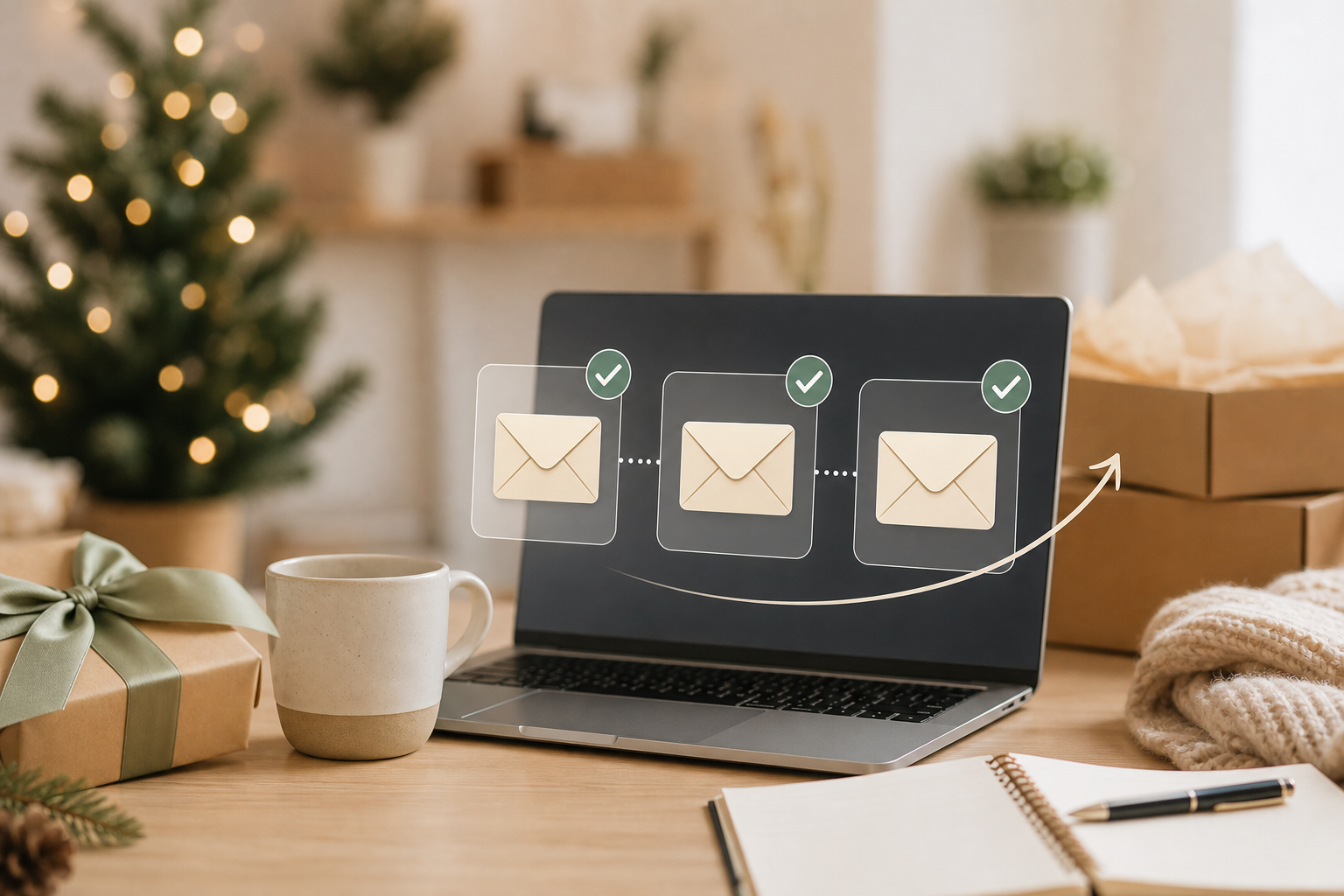
Most December holiday shoppers will not return. Without a deliberate reactivation plan, the customers who tried your salon, cafe, or gym once in December will fade into the January rush and never come back. The goal of a post-holiday reactivation campaign is simple: give those one-time visitors a clear reason and an easy path to book or order again in February.
This guide walks through a three-email sequence you can deploy in early January, with specific timing windows, offer examples, and benchmarks drawn from recent email data. The strategy works for beauty and personal-care businesses, food and beverage operators, and health and fitness studios. It requires December purchase or visit data, basic email segmentation, and a way to track February repeat visits against a holdout group.
Why most holiday shoppers do not return
Research indicates that a large majority of holiday shoppers do not buy again within six months. One analysis found that only sixteen percent of customers who purchased one item during a holiday season ordered again at all. These figures come from different datasets and should be treated as directional rather than universal, but the pattern is consistent: acquiring a customer in December does not guarantee a second visit in January or February.
The reasons are straightforward. Holiday shoppers may have been buying gifts, trying your business for convenience, or redeeming a discount that does not reflect your normal value. Without a follow-up offer or reminder, they have little reason to return when their own routines resume in January. A reactivation sequence bridges that gap by acknowledging their December visit and giving them a relevant next-visit incentive with a clear deadline.
The three-email reactivation sequence
This sequence is built around three sends over four weeks in January. Each email has a specific job, and each should suppress recipients who have already returned or redeemed an earlier offer. The final measure of success is the February repeat-visit rate for your December cohort, compared with a randomly selected group that did not receive the campaign.
Email one: the holiday thank-you offer
Send this email between January third and seventh. The message acknowledges the customer's December visit and offers a next-visit perk valid through the end of January. The offer should be specific, redeemable in one step, and margin-safe.
For a salon, offer a complimentary add-on with any booked service. For a cafe, offer a free drink or pastry with a minimum purchase. For a gym, offer a guest pass or free class. Keep the terms simple and the booking or redemption link prominent.
Use industry open-rate benchmarks as a reference point. Beauty and personal-care emails average a thirty-eight-point-four percent open rate, restaurant and cafe emails average forty-four-point-three-two percent, and health and fitness emails average forty-seven-point-eight-one percent. Your own list may perform above or below these figures depending on recency, engagement history, and subject-line clarity.
Email two: the mid-month reminder
Send this email between January twelfth and sixteenth to recipients who have not yet redeemed the first offer. Suppress anyone who has already visited or booked. The goal here is to lower friction and give a concrete reason to act before the end of the month.
A salon can suggest a specific follow-up service based on what the customer booked in December. A cafe can highlight a weekday reward or a new menu item. A gym can invite the recipient to a particular class or a short consultation. Include the original offer and a clear expiration reminder.
Industry click-rate benchmarks are zero-point-nine-five percent for beauty and personal care, one-point-zero-six percent for restaurants and cafes, and one-point-four-five percent for health and fitness. Clicks matter only if they lead to bookings or orders, so track the full funnel from open to redemption.
Email three: the last-chance nudge
Send this email between January twenty-fifth and twenty-ninth to recipients who still have not returned. State the expiration date, repeat the booking or redemption link, and keep the message short. Do not automatically escalate the discount. A clear reminder or a small bonus may be enough to convert fence-sitters without eroding margin further.
The real measure at this stage is not click rate but February repeat-purchase or visit rate for the December cohort. Compare that rate with a holdout group that received no offer. The difference estimates the incremental lift your campaign created.
Setting realistic benchmarks and tracking results
Across millions of email campaigns, the median open rate in early twenty twenty-five was forty-three-point-four-six percent, the click rate was two-point-zero-nine percent, and the click-to-open rate was six-point-eight-one percent. These broad averages provide useful context, but the industry-specific figures above are better starting points for salons, cafes, and gyms.
Do not treat opens or clicks as conversions. A conversion in this context means a booked appointment, a completed order, or a redeemed offer. The ultimate success metric is the February repeat rate: how many of your December holiday shoppers came back for a second visit in February, and how does that rate compare with a control group.
Set a baseline from your own historical data. Pull the repeat rate for customers acquired in a previous month and compare it with the December cohort after the campaign concludes. Measure each step of the funnel: emails delivered, opens, clicks, bookings, redemptions, and February visits. If your December cohort shows a ten-percentage-point higher February repeat rate than the holdout group, the campaign delivered incremental value.
Offer design and execution tips
Make the reward fit your business model and protect margin. A complimentary add-on for a salon works when paired with a full-price core service. A free item for a cafe works with a minimum spend or a weekday visit window. A gym guest pass works when it leads to a membership conversation or a follow-up class booking.
Use December purchase or visit data to personalize the offer where possible. If a customer bought a particular product or booked a specific service, reference it in the thank-you email and suggest a logical next step. If your business tracks loyalty points or progress toward a reward, show that progress in the reminder emails.
Treat industry benchmarks as planning references, not promised results. Your list size, engagement history, offer clarity, and booking friction will all affect performance. A small, highly engaged list may outperform industry averages. A large, cold list may underperform. The only way to know is to measure your own baseline, test the sequence, and compare results with a holdout group.
Avoid the temptation to escalate discounts automatically in email three. If the first offer did not convert a recipient, a bigger discount may not either. Focus instead on clarity, urgency, and reducing friction in the booking or ordering process.
Measuring incremental lift with a holdout group
A holdout group is a randomly selected subset of your December holiday shoppers who do not receive the three-email sequence. This group should represent ten to twenty percent of the cohort. At the end of February, compare the repeat-visit rate of the campaign group with the repeat-visit rate of the holdout group. The difference estimates the incremental effect of your reactivation campaign.
Without a holdout group, you cannot separate customers who would have returned on their own from customers who returned because of the offer. Some portion of every holiday cohort will come back naturally. The holdout group isolates the campaign's contribution and helps you calculate the true cost per incremental visit.
Track margin alongside revenue. If your offer drives repeat visits but those visits carry lower margins than your baseline, the campaign may not be profitable. Compare the average margin per visit for the campaign group with the holdout group, and adjust future offers accordingly.
Common mistakes to avoid
The most common mistake is treating the campaign as a January revenue driver rather than a February retention play. Clicks and redemptions in January are leading indicators, but the real outcome is whether those customers establish a repeat habit. Measure February visits, not just January engagement.
Another mistake is sending the same offer to everyone regardless of December behavior. A customer who spent two hundred dollars in December may need a different incentive than a customer who spent twenty dollars. Segment by purchase value, service type, or visit frequency if your data allows it.
Do not skip the holdout group. Without it, you will not know whether your campaign created incremental visits or simply subsidized customers who would have returned anyway. The holdout group is the only reliable way to measure true lift.
Finally, do not over-complicate the offer. A multi-step redemption process, confusing terms, or unclear deadlines will suppress response rates. Make the next action obvious and friction-free.
What to do with the results
At the end of February, calculate the repeat-visit rate for your December campaign group and your holdout group. If the campaign group shows a meaningfully higher repeat rate and acceptable margins, the sequence worked. Scale it for future holiday cohorts and test variations in timing, offer type, and messaging.
If the campaign group underperformed or showed no lift over the holdout group, review each step. Check open rates, click rates, booking conversion, and redemption rates. Identify where the funnel broke down and test a revised sequence with the next cohort.
Use the data to refine your offer strategy. If a free add-on drove more repeat visits than a percentage discount, lean into add-ons in future campaigns. If email two outperformed email one, test leading with the mid-month framing next time.
The December holiday rush brings a surge of first-time customers. A three-email January sequence gives you a structured, measurable way to turn some of those one-time shoppers into February regulars. Track the right metrics, protect your margins, and measure against a holdout group. The result is a repeatable reactivation process that works for your business and your customers.
Sources
- Email marketing benchmarks by industry and region for 2026
- What are good email open rates and click through ...
- Holiday Loyalty Campaigns: Turning Seasonal Shoppers Into Members - Blings
- Email Marketing Benchmarks by Industry (2026) | SaaS Scored
- Turn Holiday Shoppers Into Repeat Customers This January
- Email marketing benchmarks: What good looks like in 2026
- Email Marketing Benchmarks for 2025
- Getting Your Loyalty Program Ready for the Holidays
- How Can Loyalty Programs Turn Holiday Shoppers Into Regulars?
- Email marketing benchmarks by industry (+ email open ...