
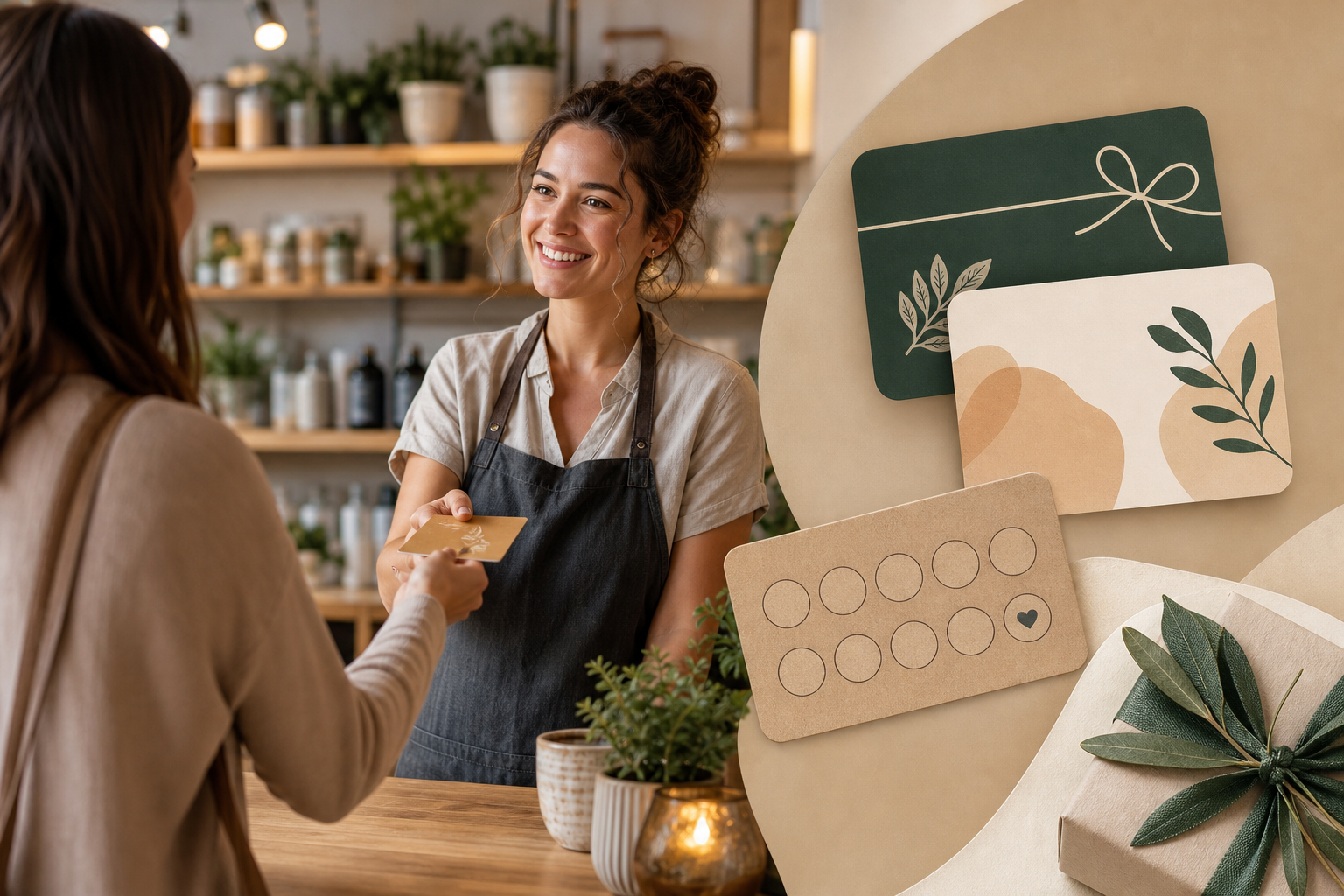
Gift cards solve two problems at once. When someone buys a card, you acquire a new customer or deepen a relationship with an existing one. When that card gets redeemed, you create a return visit. Most small shops stop there. The opportunity is to turn that return visit into the start of a loyalty loop.
This matters because acquisition is expensive and retention is high-leverage. Finding a new customer costs 5 to 7 times more than keeping an existing one. A 5% increase in retention can lift profits by 25% to 95%. Repeat customers spend 67% more than new customers, and loyalty members generate 12% to 18% more incremental revenue growth per year than non-members.
Yet 73% of small business owners operate without a formal loyalty program. That gap is your advantage. If you already sell gift cards, you have the infrastructure. You just need to connect the dots.
Why gift cards are natural loyalty drivers
A gift card creates prepaid value. The customer has already committed money to your shop. The friction to return is lower than for a cold prospect, who has to decide whether to visit at all. The redeemer has a concrete reason to come back: a balance to spend.
The research backs this up. Repeat customers visit twice as often as new customers. On any given visit, a returning customer has a 60% to 70% chance of converting, compared to 5% to 20% for a first-timer. That conversion gap is your window.
The mistake is treating redemption as the end. It's actually the middle. The customer used part of the card, now has a remaining balance, and will make a decision about whether to return. Your job is to make that decision easy and rewarding.
Link gift card balances to your loyalty loop at checkout
Every time a customer pays with a gift card, show the remaining balance on the receipt, in an SMS, or in your loyalty app. Then add a next-step incentive.
Example: "You have $12.40 left—come back within 14 days and earn a bonus stamp."
This does three things. It makes the balance visible, so the customer doesn't forget about it. It sets a time boundary, which creates urgency. And it ties the return visit to a loyalty reward, so redemption becomes part of a longer relationship.
Timing matters. Loyalty card research shows that completion rates collapse when the expected wait to reward stretches beyond 8 weeks. Cards designed to complete in 2 to 4 weeks saw 11.4% completion. Cards taking 16 weeks or longer fell to under 1%. For gift cards, that means your follow-up offers should be immediate and time-bounded, not vague.
Award loyalty points on the full purchase, not just out-of-pocket
When a customer uses a gift card, count the entire transaction value for loyalty points, not just the amount they paid in cash or credit.
If someone buys $30 of goods and uses a $20 gift card, award points on $30. This keeps earning power consistent across visits and makes the gift card feel like a real transaction, not a discount.
Many point-of-sale systems default to awarding points only on the paid portion. Change that setting. The customer already funded the card. Penalizing them for redeeming it undercuts the loyalty loop.
Use redemption triggers to create the next visit
Offer a bonus for the visit immediately after a gift card redemption.
Example: "Used your gift card today? Earn 2x points on your next visit within 30 days."
This turns balance depletion into a return incentive. The customer spent down part of the card and now has a reason to come back before the bonus expires. You're stacking two motivations: the remaining balance and the multiplier.
Segment by redemption stage. First-time redeemers get a "thank you and here's what's next" message. Partial-balance users get a reminder to finish the card. Nearly empty balances get a loyalty enrollment offer.
Make the balance visible everywhere
A customer is more likely to return if checking the remaining value is effortless. Offer balance lookup in-store, on your website, and from a mobile receipt.
If you use a loyalty platform, integrate gift card balances into the app. The customer opens the app to check points and sees the gift card balance in the same view. That reduces the mental effort to redeem and increases the odds of a return visit.
For shops without an app, SMS works. After each redemption, send a text with the remaining balance and a one-tap link to store hours or directions.
Bridge leftover balances to loyalty enrollment
Many gift cards end up with small residual amounts—$3, $5, $7—that feel awkward to spend. Use that threshold as a membership prompt.
Example: "You have $4.75 left. Join our free loyalty program and we'll add 50 bonus points to your next purchase before this balance expires."
The leftover balance becomes the reason to enroll, and enrollment creates a reason to return. You're converting an accounting leftover into a relationship asset.
Treat the gift card sender as an acquisition channel
When someone buys a gift card for another person, ask for the recipient's email or mobile number. Offer to send a digital greeting or redemption reminder.
Once the recipient redeems for the first time, send a "welcome back" offer within 48 hours. Example: "Thanks for visiting us. Here's a bonus offer for your next trip."
The sender brought you a new customer. The redemption gave you permission to contact them. The follow-up offer turns that contact into a second visit.
Among programs that measure ROI, 83% report positive returns, with an average return of 5.2 times cost. For small shops, the ROI comes from repeat visits, not elaborate point structures. A gift card redeemer who comes back twice is already more valuable than a one-time buyer.
The business case in three steps
Gift cards create upfront cash flow and acquire new customers through gifting. Redemption creates return traffic and more chances to convert those customers to loyalty members. Loyalty increases the odds of future full-price visits, higher spending, and referrals.
Consumers respond to this loop. 79% say loyalty programs make them more likely to keep buying, and 73% are more likely to recommend brands with good loyalty programs.
The gap is execution. Most small shops stop at the sale. A few track redemptions. Almost none tie redemptions to the next visit or to a membership offer.
How to implement in 30 days
Week one: update your point-of-sale system to award loyalty points on the full transaction value when a gift card is used.
Week two: add remaining balance and a next-step offer to receipts, SMS, or your loyalty app.
Week three: create a segmented follow-up sequence—first redemption, partial balance, nearly empty balance—with time-bounded offers.
Week four: add a balance-lookup option to your website or mobile receipt, and set up a gift-card-sender opt-in at checkout.
You don't need new software. You need to connect the systems you already have and turn redemption into a relationship step instead of a transaction close.
Takeaway
Gift cards are acquisition tools that create built-in reasons to return. The shops that win treat redemption as the start of a visit sequence, not the end of a sale. Link balances to your loyalty loop, make the next visit easy and rewarding, and turn one-time buyers into regulars.
Sources
- https://extu.com/blog/loyalty-program-statistics/
- https://www.loyaltypass.co/blog/guide/loyalty-program-statistics
- https://www.sumup.com/en-us/press/loyalty-data-story/
- https://easyappsecom.com/vi/guides/shopify-rewards-program-statistics-2026
- https://www.sellerscommerce.com/blog/customer-loyalty-statistics/
- https://emarsys.com/learn/blog/customer-loyalty-statistics/
- https://www.favecard.co/en/blog/loyalty-card-completion-rate-study/
- https://digitalloyalty.com/blog/loyalty-program-statistics-every-small-business-owner-should-know-in-2026
- https://antavo.com/blog/customer-loyalty-statistics/
- https://queue-it.com/blog/loyalty-program-statistics/
- https://blackhawknetwork.com/resources/blog/effective-customer-loyalty-program-and-incentives-work