
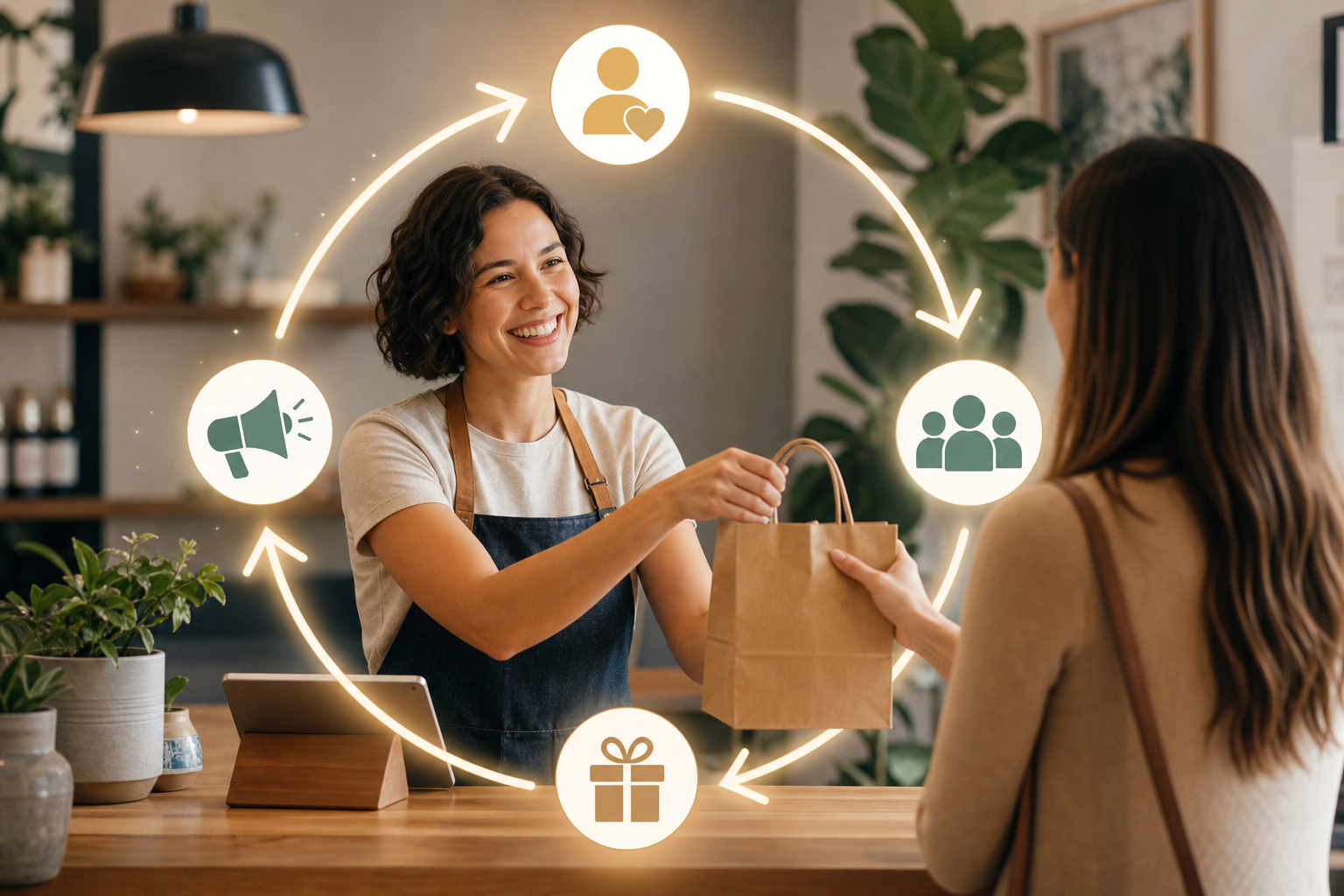
In 2025, 78% of consumer referral programs are double-sided, meaning they reward both the person making the referral and the new customer they bring in. That shift reflects a simple truth: referral program ideas for small business work best when both parties have skin in the game. A dual-sided reward structure increases participation by 29% compared with single-sided programs, and the payoff is measurable. Strong referral programs can drive 10–30% of store revenue, with some shops seeing a 20–30% revenue lift in the first year.
The challenge for most small shops is not whether to launch a referral program, but how to structure it so customers actually use it. The answer is a three-step reward ladder that triggers at the moments people are most likely to act: signup, first visit, and second visit. This approach transforms referrals from a one-time coupon into a retention engine that turns every new customer into your next promoter.
Why Double-Sided Referral Programs Outperform Single-Sided Offers
Referral marketing is trust-based, not ad-based. 86% of consumers say recommendations and reviews matter in purchase decisions, while only 2% consider traditional ads important. When you ask a loyal customer to refer a friend, you are asking them to put their reputation on the line. A double-sided program acknowledges that social capital by rewarding both parties.
In practice, 54% of double-sided programs give the same reward to both the referrer and the referred customer. That symmetry simplifies the offer and removes any perception that one side is getting shortchanged. Simplicity matters: simple referral programs convert 2.6 times better than complex multi-step programs.
Referred customers are also more valuable than customers from other channels. They convert 3–5 times higher, spend 11% more per purchase, and are more likely to return. One benchmark set puts the median conversion rate for e-commerce referral programs at 3–5%, with top-quartile programs reaching 8% or higher. For local shops, those numbers translate to measurable traffic and repeat business.
The Three-Step Reward Ladder: Signup, First Visit, Second Visit
The most effective referral program ideas for small business tie rewards to three specific actions. Each step reinforces the behavior you want and moves the new customer deeper into your retention funnel.
Step One: Reward the New Customer at Signup
Give the new customer a small immediate reward when they sign up using a referral link. This can be a discount code, a free add-on, or a points bonus they can redeem on their first visit. The goal is to make the referral feel real right away, so the new customer has a concrete reason to walk through your door.
64% of business leaders use welcome rewards to keep referred customers engaged. The reward does not need to be large, but it does need to be easy to understand and quick to redeem. A coffee shop might offer a free pastry with any drink purchase. A salon might give 20% off the first service. A retail store might add 500 points to the new customer's account, redeemable immediately.
Step Two: Reward the Advocate After the First Visit
Issue the advocate their first reward only after the referred customer completes their first visit or purchase. This prevents low-quality referrals and ensures the advocate is rewarded for bringing in real traffic, not just email signups.
The advocate's reward can be the same as the new customer's signup offer, or it can be a cash-equivalent credit. Gift cards are reported as the most effective referral reward mechanism in one 2025 compilation. Store credit works well too, especially if your shop already runs a loyalty program. The key is to make the payout automatic and instant, so the advocate sees the result of their referral without having to ask.
Step Three: Unlock a Second Reward After the New Customer Returns
After the new customer makes their second visit, unlock an additional reward for both the advocate and the new customer. This step turns the referral from a one-time transaction into a retention loop. The second reward can be smaller than the first, but it should be meaningful enough to drive a return visit.
For example, a coffee shop might give both parties a free drink after the second visit. A salon might offer a product sample or a discount on the next service. A retail store might add bonus points or a small gift card. The second visit is the inflection point where a referred customer starts to look like a regular, and this reward tier reinforces that behavior.
Practical Referral Reward Ideas That Work for Local Shops
The best referral rewards are simple, immediate, and easy to track. Here are seven referral program ideas for small business that fit the three-step ladder.
- **Coffee shop:** New customer gets a free pastry at signup. Advocate gets a free drink after the first visit. Both get a free drink after the second visit.
- **Salon or spa:** New customer gets 20% off their first service. Advocate gets a product sample after the first visit. Both get 15% off after the second visit.
- **Retail store:** New customer gets 500 points at signup. Advocate gets 500 points after the first purchase. Both get 1,000 points after the second purchase.
- **Gym or studio:** New customer gets a free class at signup. Advocate gets a free class after the first visit. Both get a free month upgrade after the second visit.
- **Restaurant:** New customer gets a free appetizer at signup. Advocate gets a gift card after the first visit. Both get a discount on their next meal after the second visit.
- **Pet store:** New customer gets a free toy at signup. Advocate gets store credit after the first purchase. Both get a product bundle after the second purchase.
- **Bookstore or gift shop:** New customer gets 10% off at signup. Advocate gets a gift card after the first purchase. Both get a branded tote or bonus credit after the second purchase.
Cash-equivalent rewards and store credit are usually easier to understand than points systems. If you do use points, make sure the redemption threshold is low enough that customers can use their reward quickly.
How to Promote Your Referral Program Without Adding Work
Even the best referral program ideas for small business will not work if customers do not know they exist. 83% of satisfied customers would refer after a positive experience, but only 29% do so without a prompt or incentive. That gap is your opportunity.
Promote your referral program at three high-intent moments: at checkout, in receipt emails, and in follow-up messages. At checkout, mention the program verbally or print it on the receipt. In receipt emails, include a one-click referral link. In follow-up messages, remind customers they can earn rewards by sharing.
28% of U.S. business leaders say social media sharing is the best referral channel. Make it easy for customers to share by generating a unique referral link they can post on Instagram, Facebook, or text to friends. Referral email open rates are reported at 48%, compared with about 21% for standard marketing emails, so a simple email reminder can drive meaningful participation.
Companies with referral software see 2.3 times more referrals than those tracking manually. If you are using a loyalty platform, check whether it includes referral tracking and automated payouts. If not, a simple spreadsheet and a manual reward process can work for the first few months, but automation scales better as your program grows.
Why Referred Customers Are Worth More Than Paid Ads
88–90% of consumers trust recommendations from friends more than advertising. That trust translates to higher conversion rates, larger basket sizes, and better retention. Referred customers spend 11% more per purchase and are more likely to become repeat buyers. In other words, a referral is not just a new customer—it is a higher-quality customer who is easier to retain.
For local shops, referrals also cost less to acquire than paid ads. A double-sided referral program has an upfront cost in the form of rewards, but those rewards are paid only after a customer converts. That makes referrals a performance-based channel with a predictable return.
Sample Referral Offer for a Local Coffee Shop
Here is a ready-to-use referral offer for a coffee shop that follows the three-step ladder:
**Your friend gets:** A free pastry with any drink purchase when they sign up using your referral link.
**You get:** A free drink after your friend makes their first purchase.
**You both get:** Another free drink after your friend's second visit.
This offer is simple, symmetrical, and tied to real visits. The new customer sees immediate value, the advocate is rewarded for bringing in a paying customer, and both have a reason to return. You can adapt this structure to fit any type of shop by swapping in the rewards that make sense for your business.
Three Mistakes to Avoid When Launching a Referral Program
First, do not make the reward too small. If the offer does not feel worth sharing, customers will not share it. Aim for a reward that is meaningful enough to drive action but not so large that it erodes your margin.
Second, do not wait too long to pay out. The advocate should see their reward within hours or days of the referred customer's first visit, not weeks later. Delayed payouts kill momentum and reduce participation.
Third, do not overcomplicate the rules. A program with multiple tiers, expiration dates, and fine print will confuse customers and reduce conversions. Keep the offer to one sentence and make the mechanics invisible.
Turning New Customers Into Your Next Promoters
The best referral program ideas for small business are the ones that create a self-sustaining loop. When you reward both the advocate and the new customer at signup, first visit, and second visit, you turn every new customer into a potential promoter. That loop compounds over time, because referred customers are more likely to refer others.
In 2025, referral marketing is not a tactic—it is a channel. Shops that treat it as such, with clear offers, simple mechanics, and automated tracking, see measurable returns. Start with a double-sided program, tie rewards to real visits, and promote it at the moments customers are most engaged. The customers who trust you enough to walk through your door will trust you enough to bring their friends.
Sources
- https://impact.com/referral/top-10-referral-marketing-statistics/
- https://marketingltb.com/blog/statistics/referral-marketing-statistics/
- https://www.extole.com/blog/15-referral-marketing-statistics-you-need-to-know/
- https://www.referralcandy.com/blog/referral-program-benchmarks-whats-a-good-conversion-rate-in-2025
- https://www.rivo.io/blog/referral-program-statistics
- https://www.shno.co/marketing-statistics/incentivized-referral-statistics
- https://artios.io/referral-marketing-statistics-usa-2025/
- https://seosandwitch.com/referral-marketing-statistics/
- https://www.mevrik.com/blog/referral-marketing-statistics
- https://entrepreneurshq.com/referral-marketing-statistics/
- https://www.shopify.com/blog/referral-marketing-statistics
- https://www.shno.co/marketing-statistics/referral-program-statistics
- https://electroiq.com/stats/referral-marketing-statistics/
- https://wifitalents.com/referral-statistics/
- https://www.twinstrata.com/referral-marketing-statistics/
- https://www.salesforce.com/blog/small-business/referral-program-ideas/
- https://www.tapmango.com/blog/referral-program-examples/
- https://www.zendesk.com/blog/customer-experience/feedback/customer-referral-program/
- https://www.yotpo.com/blog/how-do-referral-programs-work/
- https://www.celerant.com/blog/how-to-build-a-customer-referral-program/