
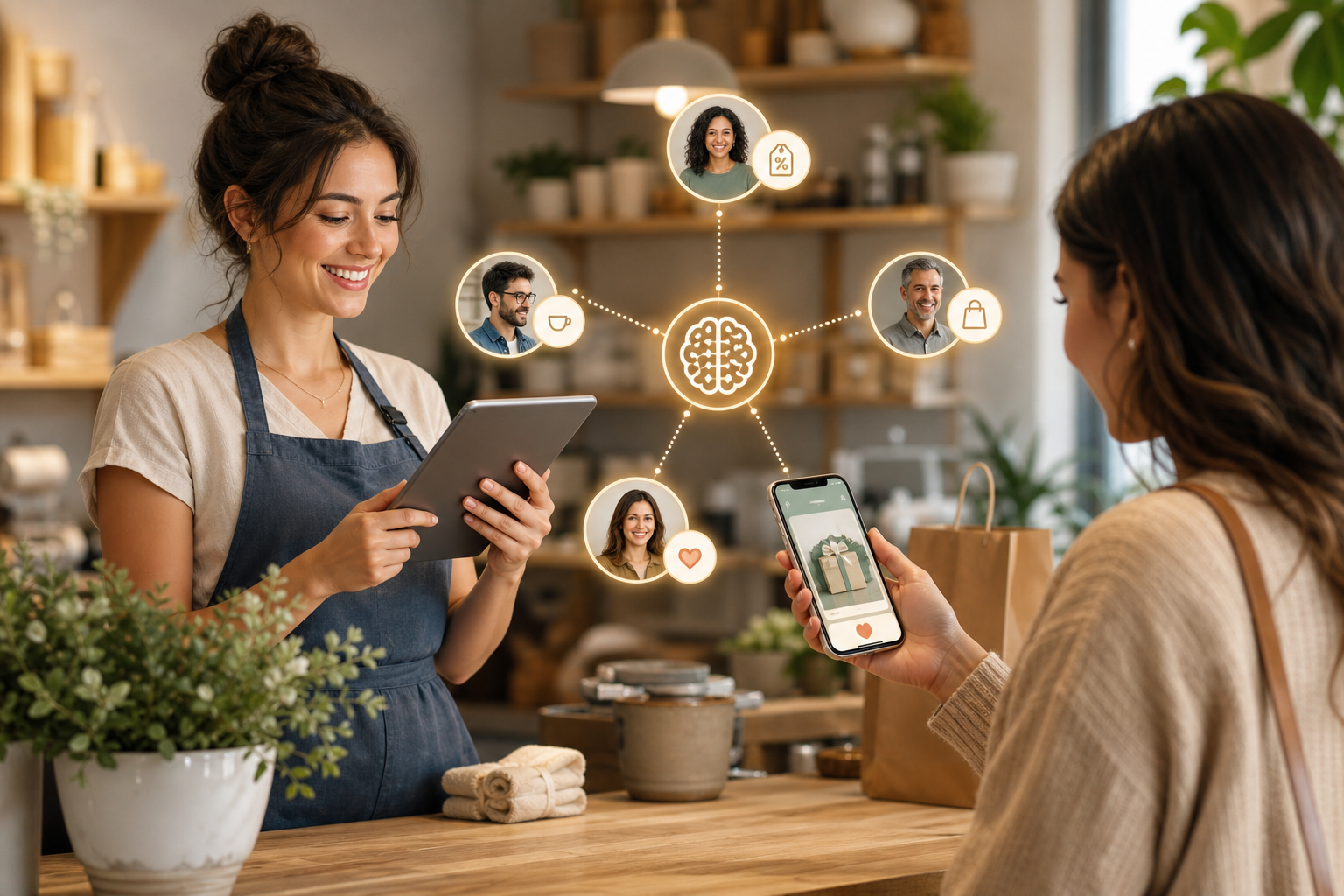
Sending the same discount to every customer is leaving money on the table. A first-time browser doesn't need the same incentive as a repeat buyer who hasn't shown up in three months, and your best customers shouldn't be getting the same generic coupon as someone who abandoned their cart last week.
Until recently, that level of targeting required a data team. Now, AI personalized offers for small business are built into affordable tools that run on autopilot once you connect your customer data. You can trigger the right offer to the right person at the right time based on purchase history, visit frequency, and churn risk without writing a line of code.
How AI Decides Which Offer to Send
AI-driven personalization works by analyzing patterns in your existing customer data. The system looks at purchase history, browsing behavior, email engagement, and time since last visit, then assigns each customer to a segment and triggers an offer that matches their behavior.
Instead of you manually deciding who gets what, the platform uses recommendation engines, predictive churn scoring, and segmentation logic to automate the decision. For example, a customer who bought running shoes three months ago might get a replenishment reminder for socks. A shopper who abandoned a cart gets a nudge within 24 hours. A lapsed customer who used to visit monthly but hasn't been back in 90 days receives a win-back offer with a higher discount than your regular promotion.
The key is that these systems don't require you to build models yourself. The AI is pre-trained and packaged into workflows you can switch on with a few clicks.
Four Customer Segments Every Small Shop Should Use
You don't need a complex data model to get started. Most small businesses see results by focusing on four simple segments that AI tools can identify automatically.
First-time buyers are people who just made their first purchase. The goal here is to bring them back quickly, so a post-purchase follow-up with a small incentive or product recommendation within a week keeps momentum going.
Repeat buyers are your regulars. They already trust you, so personalized product suggestions based on past purchases work better than blanket discounts. If someone buys coffee beans every month, a replenishment reminder timed to their usual cycle is more valuable than a random sale email.
Lapsed customers haven't purchased in 60 to 90 days despite prior activity. These are win-back candidates. A targeted offer with a clear reason to return—new stock, a loyalty reward, or a time-limited discount—can pull them back before they forget about you entirely.
High-value customers spend more and visit more often. Treat them differently. Early access, VIP perks, or personalized thank-you messages reinforce their loyalty without training them to wait for discounts.
Automated Offers That Work Without Manual Work
Once your segments are in place, AI tools can trigger offers based on behavior, not your memory or a spreadsheet.
Abandoned-cart sequences are the most common starting point. When a shopper adds items but doesn't check out, the system sends a reminder email within a few hours. If they still don't convert, a second message with a small incentive—free shipping or a percentage off—often closes the sale. This works because the timing is automatic and the offer is contextual.
Win-back campaigns target customers who haven't purchased recently. The AI identifies when someone crosses your lapsed threshold and sends a tailored message. You set the rules once, and the system runs it forever.
Product recommendations appear in emails, on-site, or at checkout based on browsing and purchase history. If a customer bought a camera, the next email might suggest lenses or a case. If they browsed jackets but didn't buy, a follow-up highlights similar styles or a price drop.
Replenishment reminders work for consumables and repeat-purchase products. If your data shows a customer buys skincare every 45 days, an email on day 40 with a reorder button increases the chance they buy from you instead of wandering to a competitor.
Post-purchase follow-ups can request a review, offer a loyalty reward, or suggest complementary products. Automating this sequence means every customer gets the same high-touch experience without you lifting a finger after the first setup.
Tools That Bring AI Personalization to Small Businesses
The barrier to entry has dropped significantly. Several platforms now offer AI-driven segmentation and offer automation at prices that make sense for independent shops.
Shopify's native AI features include product recommendations, predictive analytics, and personalized email suggestions. Pair it with Klaviyo, which starts at $20 per month, and you have abandoned-cart recovery, win-back flows, and behavior-triggered campaigns in one stack. This is the most common setup for small ecommerce businesses because it integrates tightly and requires minimal technical skill.
Nosto focuses on on-site product recommendations and starts at $99 per month. It delivers Amazon-style suggestions without custom engineering, useful if you want to increase average order value through better merchandising.
CleverTap offers omnichannel personalization across email, push notifications, and in-app messaging for $75 per month for up to 5,000 users. It's a good fit if you have a mobile app or want to coordinate offers across multiple touchpoints.
Tidio has a free plan and paid tiers from $29 per month. It adds AI chat to product pages and checkout, reducing friction and answering questions in real time, which indirectly supports conversion without requiring you to staff a live chat all day.
Intercom starts at $74 per month and is designed for hyper-personalized customer service and communication. If retention hinges on fast issue resolution or proactive support, this is a practical choice.
HubSpot Breeze bundles predictive scoring, campaign automation, and content optimization into an all-in-one CRM and marketing platform. It's positioned for businesses that want email, segmentation, and customer data in a single system rather than stitching together multiple tools.
Zendesk AI starts at $55 per agent per month and focuses on support automation. Speed and service quality drive retention in many small businesses, so AI that routes tickets and suggests responses can indirectly improve loyalty and repeat purchase rates.
How to Set Up Your First AI Offer Campaign
Start with one high-impact use case rather than trying to automate everything at once. Abandoned-cart recovery is the easiest win because the behavior is clear, the intent is high, and the setup is straightforward in most platforms.
Connect your store or point-of-sale system to your email or messaging tool. Most integrations are plug-and-play and take less than an hour. Once connected, the platform can see purchase history, cart activity, and customer contact information.
Turn on product recommendations if your platform offers them natively. Shopify, BigCommerce, and WooCommerce all have built-in or one-click options that require no configuration beyond enabling the feature.
Create your first automated flow. Start with an abandoned-cart sequence: one reminder after a few hours, a second with a small incentive if they don't convert. Then add a win-back flow for customers who haven't purchased in 90 days. Use the segmentation features in your tool to define the trigger conditions, write two or three email templates, and let the system run.
Measure repeat purchase rate and customer lifetime value rather than just open rates or clicks. The goal is to increase how often people buy and how much they spend over time, not just to send more emails. Most platforms include basic reporting that shows revenue per campaign and cohort behavior.
Test one variable at a time. Try different discount levels for lapsed customers, vary the timing of replenishment reminders, or A/B test product recommendations. Small adjustments compound when the system runs continuously.
What Good Looks Like in the First 60 Days
A realistic target for a basic personalization rollout is a 10 percent lift in conversion or repeat purchase rate within 60 days. That means if 5 percent of email recipients were buying before, you're aiming for 5.5 percent after you switch on segmentation and behavioral triggers.
You should also see higher engagement rates—more opens and clicks—because the offers are relevant. A lapsed customer getting a win-back deal is more likely to open than someone receiving a generic newsletter.
Customer lifetime value is the long-term metric. Personalized offers increase the frequency and size of repeat purchases, which means each customer is worth more over their relationship with your business. Track CLV by cohort to see whether customers acquired or re-engaged through AI campaigns spend more than those who came through broad promotions.
Common Mistakes to Avoid
Don't over-discount. Personalization is about relevance, not deeper discounts. A timely replenishment reminder often works without any incentive. A product recommendation based on past purchases doesn't need a coupon attached. Save your margin for win-back offers and cart recovery where the customer is already on the fence.
Don't ignore frequency caps. Just because you can send triggered emails doesn't mean you should send five in a week. Set rules that prevent customers from being bombarded, especially if they're in multiple segments. One message per customer per week is a reasonable starting point.
Don't set it and forget it forever. Automated doesn't mean static. Review performance monthly, refresh your messaging seasonally, and adjust your lapsed-customer window or discount levels based on what the data shows. The AI handles the targeting; you still own the strategy.
Why This Matters Now
Customer acquisition costs are rising, and attention spans are shrinking. Generic promotions get ignored. Personalized offers feel like service, not spam, and they convert at higher rates because they align with where the customer already is in their journey.
Small businesses that adopt AI personalized offers for small business now have an edge over competitors still blasting the same message to everyone. The tools are affordable, the setup is faster than it's ever been, and the return—more repeat purchases, higher lifetime value, less wasted spend on irrelevant promotions—is measurable within weeks.
Start with one segment, one trigger, and one offer. Let the system learn, watch what works, and expand from there. You don't need a data scientist. You just need to connect the tools you already use and let your customer data do the work.
Sources
- https://robertmartinless.com/ai-customer-loyalty/
- https://www.salesforce.com/marketing/ai/best-ai-marketing-tools/smb/
- https://www.preferredpatron.com/blog/2026/04/06/best-ai-tools-marketing-customer-loyalty/
- https://www.gwi.com/blog/ai-marketing-tools
- https://twilitype.ai/blog/best-ai-tools-personalized-marketing-2025
- https://ai.advalorem.io/reports/ai-retail-personalization-loyalty-2026.html
- https://insiderone.com/ai-personalization-tools/
- https://misspepper.ai/ai-marketing/brand-loyalty-tools/best-ai-tools-customer-retention/
- https://www.data-mania.com/blog/10-ai-personalization-tools-for-personalized-marketing/
- https://www.thehartford.com/insights-center/business-management/ai-tools-on-budget
- https://reportgarden.com/post/ai-marketing-tools
- https://ciderhouse.media/best-ai-marketing-tools-for-small-businesses/
- https://www.nector.io/blog/ai-tools-loyalty-optimization-post-purchase
- https://ismartcom.com/blog/how-ai-marketing-will-revolutionize-small-business-strategies-in-2025/
- https://www.getvms.com/ai-tools-for-small-business/
- https://clevertap.com/blog/best-ai-personalization-tools/
- https://vwo.com/blog/ai-personalization-tools/
- https://businessnucleus.com/top-10-ai-tools-for-small-business-in-2025/
- https://www.youtube.com/watch?v=fD372utYVVU&vl=en
- https://www.uschamber.com/co/grow/marketing/ai-tools-for-small-business-marketing