
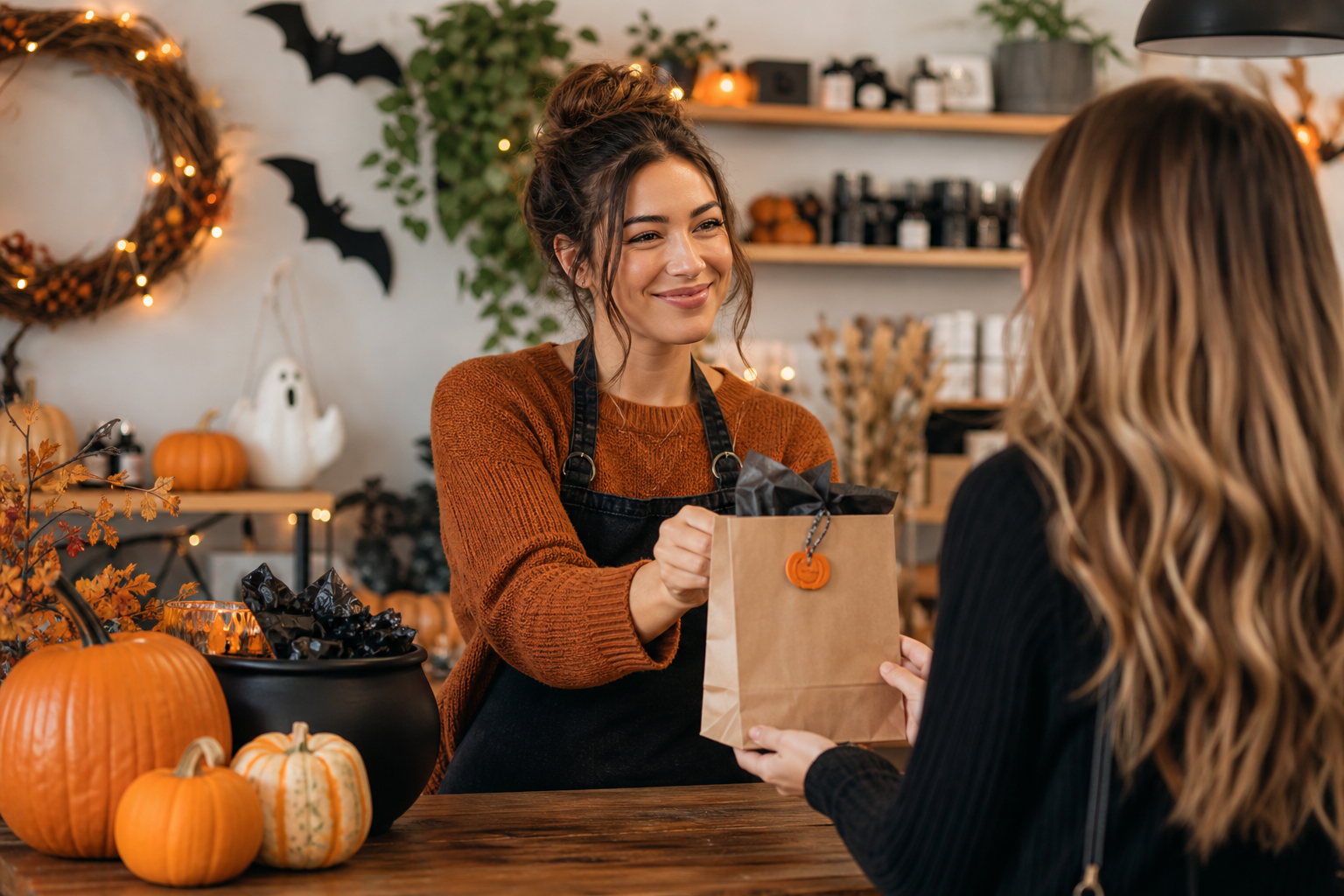
Halloween is a major seasonal shopping moment. The National Retail Federation estimated $13.5 billion in U.S. Halloween spending for 2026, with consumers planning to spend an average of $115.14. Seventy-four percent of consumers planned to celebrate, and 49 percent said they would start shopping in September or earlier.
For small shops, the opportunity extends beyond the holiday itself. Thirteen percent of consumers planned to make Halloween purchases at local and small businesses in 2026, nearly double the 7 percent reported in 2016. The question is how to turn those seasonal shoppers into customers who return in November.
A Halloween promotion that includes a November follow-up reward gives you a practical answer. The mechanics are straightforward: customers earn a bonus during the Halloween period, then redeem it during a short window in early November. Automated reminders keep the offer visible without extra manual work.
Design the Halloween earn mechanic
Start by deciding what qualifies a customer to earn the November reward. The simplest approach is a minimum purchase threshold during a defined window, such as October 29–31. You can also award bonus points on specific seasonal items like costumes, decorations, or candy, all of which see strong demand. Planned purchases included candy (96 percent), decorations (78 percent), and costumes (71 percent) according to NRF survey data.
Make the earn condition easy to understand and communicate it clearly at the point of sale. A receipt line or digital message should state the bonus earned, the customer's new balance, and the November redemption terms. Clarity at this stage sets expectations and reduces confusion later.
Avoid deep discounts. Among consumers who encounter higher-than-expected prices, 26 percent say they will look for coupons or sales, but that does not mean every offer must be aggressive. A modest, well-explained reward protects your margin while still creating a reason to return.
Set a November-only redemption window
The reward should be redeemable only in November, not at the Halloween purchase. A specific window, such as November 1–15, creates urgency without feeling arbitrary. Customers know exactly when they can use the bonus and when it expires.
Apply a minimum spend requirement if it makes sense for your margin structure, but keep it achievable. For example, a bakery might offer a $5 reward on a November purchase of $20 or more. A bookstore, café, salon, or gift shop can adapt the same structure to fit typical transaction values.
State any exclusions upfront. If the reward does not apply to certain products or cannot be combined with other offers, say so before the customer earns it. Transparency reduces friction at redemption.
Use expiration carefully and communicate it clearly
A short expiration on a promotional bonus is easier to explain than expiring a customer's regular points balance. If the Halloween bonus expires on November 15, tell customers that date when they earn the reward and again when the redemption window opens.
Before you launch, check your loyalty platform settings and any local consumer-protection rules that apply to points and rewards. Terms for expiration, forfeiture, and redemption can carry legal implications, especially if points are treated as stored value.
Transparency matters. Customers should know which points are expiring, the exact date, and how to use them before the deadline. Surprises erode trust.
Automate a short reminder sequence
Use your loyalty system to send reminders only to customers who earned the Halloween bonus. A three-message sequence works well:
- At the Halloween purchase: confirm the reward and state the November redemption terms.
- When the November window opens: remind the customer of the reward, the expiration date, and any minimum spend or exclusions.
- Mid-window: send a single "time is running out" reminder to customers who have not yet redeemed.
After the window closes, suppress further redemption reminders. You can follow up with an invitation to your next seasonal offer if appropriate, but do not keep messaging customers about an expired reward.
Send reminders through the channel the customer consented to, whether that is email, SMS, or app notification. Make opt-out straightforward and respect it immediately.
Example: a neighborhood bakery
A bakery runs a Halloween promotion from October 29–31. Any purchase during that window earns a $5 reward, redeemable November 1–15 on a purchase of $20 or more. The receipt prints the reward details. On November 1, an automated email or SMS arrives with the redemption instructions. On November 10, non-redeemers receive one reminder. On November 16, the reward expires and reminders stop.
The same structure adapts to other small businesses. A salon might offer a product credit redeemable on a November service. A gift shop could give a fixed discount on a return visit. The Halloween action should feel relevant to your business, and the November reward should encourage a second visit without discounting every transaction.
What to measure
Track these metrics to understand whether the promotion worked:
- November return-visit rate among Halloween participants
- Reward redemption rate and average November transaction size
- Incremental gross margin after subtracting the reward cost
- Number of unredeemed rewards and customer opt-outs
Compare results against a reasonable baseline if you have one, such as the same customers' behavior in a prior November or a control group that did not receive the offer. The goal is not to issue points. It is to create a clear path from Halloween purchase to earned reward to timely reminder to November visit.
Takeaway
A Halloween promotion can do more than lift one day's sales if it gives customers a concrete reason to return in early November. Use a simple earn mechanic, a short redemption window, transparent expiration terms, and a minimal automated reminder sequence. The result is a seasonal offer that drives two visits instead of one, without adding manual work or eroding margin on every transaction.
Sources
- NRF Halloween Survey Shows Consumer Spending ...
- Halloween shoppers find ways to stretch their budgets
- Halloween Data and Trends
- Inside this year's Halloween spending trends
- Halloween spending expected to reach $13.5B
- Halloween Data Center
- NRF: Consumers Prep for Halloween Earlier Than Ever
- Halloween Spending Expected To Hit Record $13.5 Billion ... - Forbes
- NRF: 2026 Halloween spending expected to rise 3.82%
- Halloween spending expected to reach $13.5 billion
- Halloween spend to hit $13.5B
- AI takes a bigger role in US Halloween shopping
- Americans are spending more than ever on Halloween, but ...
- Americans are expected to spend a shocking amount
- www.favecard.co › en › blogHalloween Marketing Ideas That Bring Customers Back