
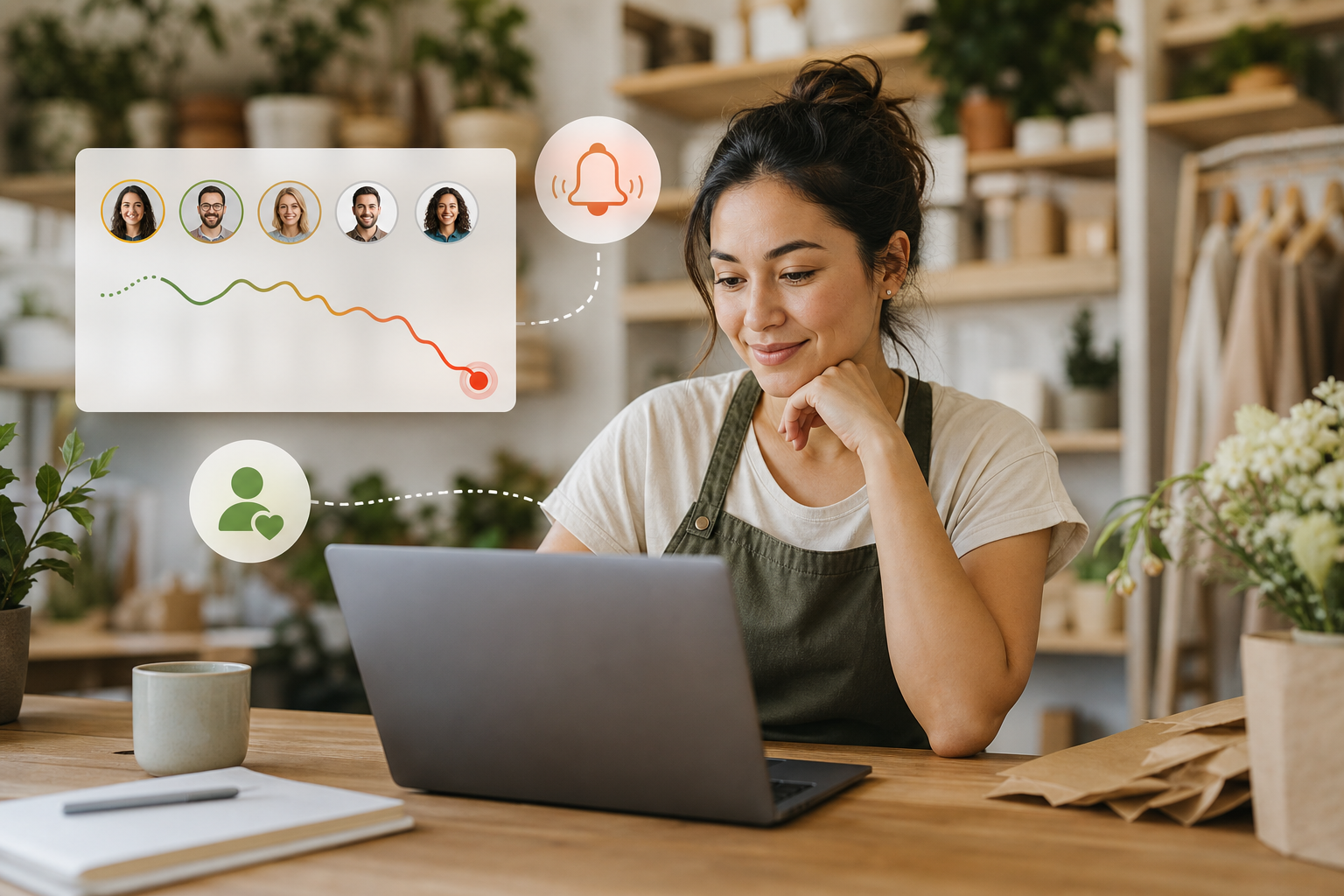
Losing a regular customer hurts more than missing out on a new one. The cafe regular who used to stop in three times a week suddenly disappears. The salon client who booked every six weeks goes silent. The gym member who attended religiously stops showing up. By the time you notice, they have already moved on.
The good news is that you can catch these customers before they leave by automating purchase gap detection and triggering immediate win-back campaigns. This approach yields a 20–40% success rate when executed quickly, and the setup requires no advanced technology.
Understanding Purchase Gap Analysis for Churn Prevention
Purchase gap analysis tracks the time between customer visits and flags when someone misses their typical window. The key metric is your average visit frequency per customer segment. When a customer exceeds 1.5 times their normal gap, they are at serious risk of churning.
For example, if your average salon client books every four weeks, a gap of six weeks is your red flag threshold. For a cafe where regulars visit every three days, a five-day absence signals trouble. This 1.5 times multiplier reliably identifies at-risk clients before they fully disengage.
Monitoring engagement frequency shows that if a monthly customer has not ordered in 45 days, that is a clear red flag. For weekly businesses, applying the same 1.5 times formula to their average gap catches slipping customers at the optimal intervention point.
Timing Formulas by Industry Type
Different businesses have different natural rhythms. Here are the concrete thresholds and response windows for three common small business types.
Cafes and Coffee Shops
Typical visit frequency is 3–4 times per week, or roughly every 2–3 days. Set your alert trigger at 5–7 days with no visit. Send your win-back message within 24 hours of crossing that threshold.
Example message hook: "Your usual coffee's waiting—come in today for a free pastry." Speed matters here because cafe habits are driven by routine and convenience.
Salons and Spas
Most clients book every 4–6 weeks for cuts, color, or treatments. Flag anyone who has not booked in 6–8 weeks. Reach out within 48 hours of hitting that mark.
Example message hook: "We miss you! Book your next style and get 15% off." Salon churn often happens because clients forget to rebook or try a competitor out of curiosity, so a timely personal nudge brings them back.
Gyms and Fitness Studios
Active members typically attend 2–3 times per week. Set your alert at 5–7 days without a login or check-in. Send your campaign within 24 hours.
Example message hook: "Your workout plan is ready—first class this week is free." Gym churn accelerates quickly once the habit breaks, making immediate outreach critical.
The Four-Step Automation Setup
You do not need expensive software or a data science team to implement this system. Most small businesses can build effective churn prevention using tools they already own.
Step One: Gather Your Data
Export purchase history from your point-of-sale system or booking platform. You need three fields: transaction date, customer identifier, and service type. Most modern POS systems let you export this as a spreadsheet.
If you use a scheduling tool like Fresha, Mindbody, or Square Appointments, these platforms already track visit frequency and can often generate gap reports automatically.
Step Two: Define Your Churn Criteria
Calculate average visit frequency for your business or for key customer segments. A VIP who comes weekly has a different threshold than a monthly regular. Set your at-risk threshold at 1.5 times the average visit frequency for each segment.
For businesses with inconsistent patterns, segment by service type. Haircut clients may visit every six weeks while color clients come every four. Track them separately.
Step Three: Set Up Automated Alerts
Use your CRM or a simple automation tool to flag customers who cross the threshold. Many loyalty platforms and email marketing tools like Mailchimp, Klaviyo, or even Google Sheets with Zapier can trigger alerts based on date calculations.
If you are using spreadsheets, create a column that calculates days since last visit and another that flags anyone exceeding your threshold. Set a daily reminder to check this list.
Step Four: Launch Triggered Campaigns
Send a personalized message within 24–48 hours of the alert. This is not a generic newsletter. Address the customer by name, reference their usual service or order, and include a concrete incentive like a free add-on, percentage discount, or simplified booking link.
Use multiple channels for better results. Combining SMS and email delivers 30% higher customer lifetime value than single-channel outreach. Text messages get opened faster, while emails allow more detail and direct booking links.
Why Speed and Personalization Drive Success
Proactive outreach including triggered win-back messages reduces churn by 15–25% overall. But timing separates successful campaigns from wasted effort. Win-back success drops significantly if you wait more than two weeks after the gap threshold.
The reason is psychological. In the first week after breaking a habit, customers still feel connected to your business. They may be busy, traveling, or trying something new but have not yet formed a replacement routine. A well-timed message reminds them of what they are missing and makes returning easy.
After two weeks, they have likely found an alternative or simply stopped thinking about your service. At that point, you are competing against inertia and possibly a new relationship with a competitor.
Personalized rewards boost loyalty engagement four times more than generic discounts. Instead of "20% off for everyone," try "Your usual latte and a pastry on us" or "15% off your next cut, plus we will fit you in this week." Reference their history and make the offer feel like recognition, not marketing.
Addressing the Likely Reason
Different customers churn for different reasons, and your message should acknowledge the most common scenarios. For salons, many clients simply forget to rebook or feel awkward reaching out after a long gap. Your message can say, "We know the holidays get busy—let's get you back on schedule."
For gyms, the most common reason is a broken routine. Try, "New group class starting Monday—your first session is free" or "We have updated your workout plan—come see what is next." Make it easy to restart without guilt or embarrassment.
For cafes, the issue is usually routine disruption or a competitor experiment. A message like, "We have missed your morning visits—your usual order is waiting" reminds them of the relationship and makes returning feel natural.
Small Businesses Using Retention Automation See Measurable Results
Small businesses that implement AI-driven or automated retention tools see 22% lower churn within six months. Even simple automation like the gap-based triggers described here produces measurable improvement because it ensures no at-risk customer slips through unnoticed.
The 90-day retention window is particularly critical. Customers who stay 90 days are 3.5 times more likely to remain loyal for a full year. This means your early intervention has compounding value. Winning back a two-month salon client is not just recovering one appointment; it is protecting years of future revenue.
Win-back campaigns succeed for 20–40% of lost customers when executed quickly. That range depends on your industry, the quality of your message, and how soon you reach out. Cafes with daily habits see higher success rates with faster outreach, while salons can recover clients even at the 48-hour mark because the decision cycle is longer.
Building the System Without Overwhelming Your Team
Many shop owners worry that monitoring gaps and sending personalized messages will consume too much time. The key is to automate the detection and standardize the outreach while keeping it personal.
Create message templates for each segment with placeholders for name, last service, and incentive. When your system flags an at-risk customer, you or a team member spend 60 seconds customizing the template and hitting send. The entire daily process takes 10–15 minutes for most small businesses.
If you have a loyalty platform or email marketing tool, build the campaign once and let it run automatically. Set the trigger conditions, write the message variants, and let the system handle delivery. You can review results weekly and tweak messaging based on response rates.
For very small operations, even a manual daily check of your spreadsheet and a few personalized texts will outperform doing nothing. The system does not need to be perfect; it just needs to be consistent.
Preventing Churn Is Cheaper Than Replacing Customers
Acquiring a new customer costs five to seven times more than retaining an existing one. Every regular you lose requires significant marketing spend, time, and effort to replace with someone new who may or may not become loyal.
Automated churn prevention flips this equation. You invest a small amount of time setting up gap tracking and a modest incentive budget for win-back offers. In return, you recover 20–40% of at-risk customers who already know and trust your business.
The customers you win back also tend to stay longer. They have experienced what it is like to be away, received a personal message showing you noticed, and been given a reason to return. That combination builds stronger loyalty than passive retention.
Practical Takeaway
Start with your best customers. Identify your top 20% by revenue or visit frequency, calculate their average gap, and set alerts at 1.5 times that number. Build one simple campaign with a strong personal hook and concrete incentive. Send it within 24–48 hours when someone crosses the threshold. Track your win-back rate for 30 days, then expand the system to the rest of your customer base. You will recover revenue that was quietly walking out the door.
Sources
- https://www.sci-tech-today.com/stats/customer-churn-statistics/
- https://searchlab.nl/en/statistics/customer-retention-statistics-2026
- https://loyaltyloop.com/blog/5-effective-strategies-reduce-customer-churn-rate
- https://www.guideflow.com/blog/reduce-customer-churn
- https://cuoral.com/blog/how-to-reduce-customer-churn-15-strategies
- https://monday.com/blog/crm-and-sales/what-is-customer-churn/
- https://www.graygroupintl.com/blog/customer-retention-strategies/
- https://fluentforms.com/reduce-customer-churn-rate-for-small-businesses/
- https://www.sparrowdesk.com/blogs/proven-customer-retention-strategies
- https://www.revechat.com/blog/reduce-customer-churn/