
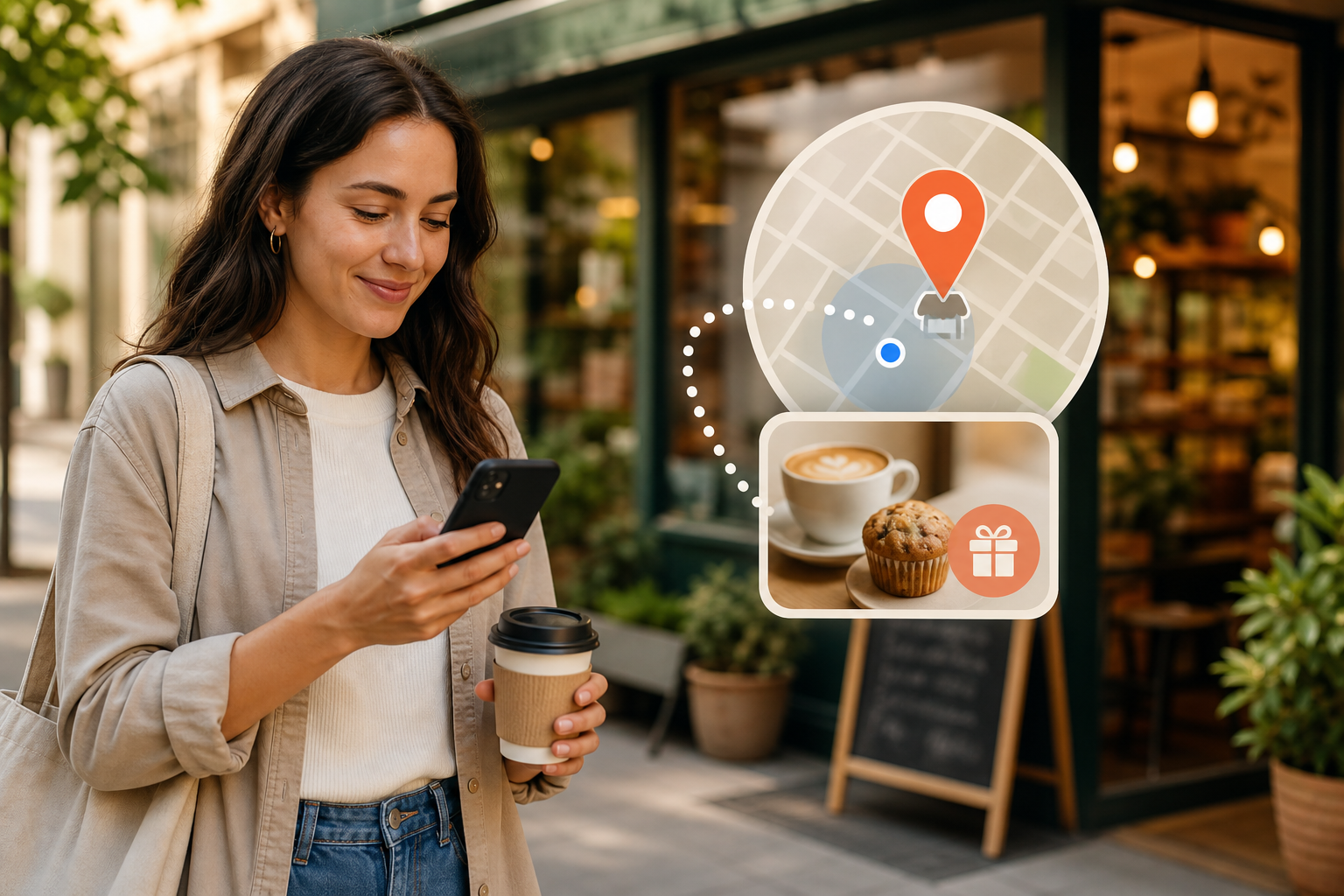
Independent shops lose potential sales every day as former customers walk past without noticing. A location based loyalty program for small business solves this by sending automated mobile offers when customers enter a defined radius around your shop, turning passive foot traffic into same-day purchases.
Geo-triggered push notifications achieve 55–65% response rates compared to 35–40% for standard messages, and they convert 15% of walk-by traffic into store visits. When a customer who hasn't visited in weeks walks within 100 meters of your coffee shop, they receive a notification: "Double points today if you visit within 1 hour." Forty percent of customers who receive these Monday morning geo-fenced messages visit that same day.
How Location Based Loyalty Programs Work
A location based loyalty program uses geo-fencing technology to detect when a customer's mobile device enters a specific area around your shop, typically a 100-meter radius. The system automatically sends a push notification to their phone with a time-sensitive offer designed to drive immediate action.
The notification appears on the lock screen even when the loyalty app isn't open. Wallet-based push notifications average 38% open rates, more than double email's 20%, with top-tier geo-targeted messages reaching 60% or higher. Unlike SMS marketing at £0.05–£0.15 per message, push notifications cost near-zero per send while maintaining delivery rates above 95%.
Shops set up automated triggers based on three factors: customer location, visit history, and reward status. When all conditions align—a lapsed customer is nearby and two stamps away from a free coffee—the system fires a personalized offer without manual intervention.
Setting Up Geo-Triggered Offers That Convert
Start by defining your geo-fence boundary. A 100-meter radius works for most high-street shops, capturing customers who are genuinely nearby without triggering notifications for people simply passing through the area on transport.
Next, create offer triggers based on customer behavior. Proximity triggers work best when customers are 2–3 stamps from completing a reward card. A bakery might send "One more visit for free pastry" when a customer with 8 stamps enters the area. Lifecycle triggers activate on milestones like "500 points reached" rather than arbitrary calendar dates.
Lapsed customer nudges only fire if someone hasn't visited in 4 or more weeks. Combine this with location data: "We've missed you! Double points today if you stop by." Adding location intelligence to behavioral triggers improves response rates by 40–60%.
Structure each message with three elements: useful information, immediate benefit, and time limit. "You're one coffee away from free! Double stamps if you visit in the next hour" outperforms vague offers. The urgency drives same-day action rather than "I'll do that sometime" thinking.
Frequency and Timing Best Practices
Send 1–2 push notifications per customer per month, or 4–6 total messages monthly across your entire customer base. Shops that send 5 or more notifications per week see rising opt-out rates as customers feel harassed rather than rewarded.
Time geo-triggered messages to match customer routines. Coffee shops send morning reminders between 7–9am on weekdays when commuters are most likely to stop. Restaurants trigger lunch offers at 11:30am for nearby office workers. Salons use afternoon notifications to fill same-day cancellations: "Book 2pm today for double points."
Beauty and wellness businesses fill 70% of same-day cancellations using this approach. Fitness studios send geo-triggered class reminders when members are nearby, boosting attendance without manual outreach.
Monitor your opt-out rate as a leading indicator of message fatigue. If opt-outs rise above your baseline, reduce frequency or improve offer relevance before you lose permission to reach customers entirely.
Results You Can Expect from Geo-Triggered Loyalty
Push notifications increase visit frequency by 23% for service businesses like salons and gyms, and 30% for retail shops. The lift comes from timely reminders that catch customers when they're already in the area and able to act immediately.
Loyalty reward users have baskets 39% larger than non-members, partly because notifications promote higher-value redemption visits. A customer redeeming a free coffee often adds a pastry, increasing transaction value beyond the core offer.
Shops see £350–£500 in additional monthly revenue per location from push-driven visits. Push notifications drive 15–30% of repeat revenue for many businesses, with loyalty programs delivering 11–16x ROI when push messaging is included.
Retention improves significantly when customers earn their first reward within 2–3 weeks of joining. Loyalty programs retain members 3–4x better when early wins are achieved, and geo-triggered offers accelerate that first redemption by creating immediate opportunities.
Industry-Specific Implementation Examples
Coffee shops benefit most from morning geo-triggers. Twenty-five percent of Pret A Manger's transactions now come from their loyalty program, driven partly by location-based messaging that reminds customers to stop during their commute.
Beauty salons use geo-fencing to fill appointment gaps. When a regular client is nearby and hasn't booked recently, they receive "Next blowout: double points if booked today." This recovers revenue from unfilled slots that would otherwise go to waste.
Boutique fitness studios combine class schedules with location data. Members receive "Spin class in 45 minutes—you're nearby!" notifications that convert intention into attendance. The reminder arrives when they're close enough to act, not hours before when they might forget.
Retail shops trigger product-focused offers based on purchase history and location. A customer who bought running shoes receives "New running gear just arrived—20% off today if you visit in the next 2 hours" when they're within range.
Technical Requirements and Costs
A functional location based loyalty program needs unlimited free push notifications, automated trigger capability, customer segmentation, and an analytics dashboard showing open rates and conversion by message type.
Total program cost runs as low as £15 per month for small shops, covering the loyalty platform, push notification infrastructure, and basic analytics. This is substantially less than SMS campaigns or paid social media advertising to reach the same customers.
The system must support scheduling and automation so you're not manually sending messages. Set up rules once—"Send double points offer to customers within 100m who haven't visited in 30 days"—and let the system execute automatically.
Delivery rate matters more than feature count. Wallet-based loyalty programs maintain above 95% delivery rates because notifications appear even when customers haven't opened the app recently. App-based programs see lower delivery as customers uninstall or disable notifications.
Measuring What Matters
Track open rate first, targeting 30–40% as your baseline. Geo-triggered messages should exceed this benchmark given their relevance. If open rates fall below 25%, test different message formats or reduce frequency.
Use cohort analysis to compare 90-day repeat purchase rates between push subscribers and customers who opted out. This shows the true retention value of your location based loyalty program beyond individual campaign metrics.
Monitor opt-out rate weekly. A sudden increase signals message fatigue or irrelevant targeting. Review your most recent campaigns to identify what triggered the change, then adjust frequency or segmentation rules.
Measure same-day conversion rate for geo-triggered offers separately from general loyalty metrics. This isolates the specific impact of location-based messaging versus other program elements. Aim for 15% of recipients visiting within 24 hours of receiving a geo-triggered notification.
Getting Started This Week
Promote loyalty sign-up at checkout using a simple prompt: "Get double points today when you join our free rewards program." Train staff to mention the program during every transaction for the first two weeks until it becomes automatic.
Launch one weekly geo-triggered offer to build baseline data. Monday morning "double points today" messages work well for coffee shops and lunch spots. Thursday afternoon offers suit retailers preparing for weekend traffic.
Set conservative frequency limits initially—one geo-triggered message per customer every two weeks—then increase based on response data. It's easier to add messages than recover from opt-out damage caused by over-messaging.
Review analytics monthly to identify which trigger combinations drive results. A customer 2 stamps from reward plus 30 days since last visit might outperform customers with more stamps but recent visits. Let data guide your automation rules.
The Reality of Location Based Loyalty
Eighty-five percent of marketers now use push notification segmentation, and 58% of consumers report they would switch brands for a better loyalty program. Location based approaches are becoming table stakes for independent shops competing against chains with larger marketing budgets.
The advantage for small businesses is intimacy and relevance. You know your regulars, their preferences, and their routines. Geo-triggered offers feel personal when they arrive at the right moment with the right incentive, not like mass marketing blasted to thousands.
Start small, test deliberately, and expand what works. A location based loyalty program converts foot traffic into revenue by meeting customers where they are—both literally and in their purchase journey—with automated offers that respect their time and reward their loyalty.
Sources
- https://perkstar.co.uk/blog/push-notifications-loyalty-programs
- https://perkstar.co.uk/blog/geo-based-push-notifications-small-business-guide
- https://www.loyaltypass.co/blog/guide/loyalty-program-statistics
- https://perkstar.co.uk/blog/how-push-notifications-work-small-business-loyalty-cards
- https://perkstar.co.uk/blog/loyalty-software-push-notifications
- https://perkstar.co.uk/blog/push-notifications-small-business-loyalty-cards
- https://snapss.io/blog/notifications-push-commerce
- https://www.businessofapps.com/marketplace/push-notifications/research/push-notifications-statistics/
- https://fidelup.be/en/blog/notifications-push-fidelite-commerces-locaux/
- https://bonusqr.com/article/push-notifications-and-customer-loyalty-2026-guide